Retailers do not need more disconnected technology. They need a connected operating model that turns every transaction into timely, trusted and actionable business information.
Retail digital transformation is often described through visible customer-facing innovations: faster checkout, ecommerce, mobile payments, loyalty programmes and click-and-collect. Yet the most consequential transformation is happening behind the experience. It is the transition from a collection of retail systems that exchange information periodically to an operating environment in which sales, inventory, customers, orders and finance remain continuously aligned.
This distinction matters because a digital storefront cannot compensate for an analogue operating model. A retailer may offer multiple channels while still relying on delayed inventory updates, spreadsheet reconciliations and separate versions of the truth. Linc’s retail materials identify precisely these symptoms: disconnected store and ERP systems, delayed inventory visibility, manual financial reconciliation and limited cross-location oversight. Microsoft similarly observes that fragmented retail data makes timely decisions, accurate inventory management and consistent customer experiences more difficult.
Fragmentation is no Longer an IT Inconvenience
Disconnected systems create costs far beyond the technology department. When a sale is completed but inventory, customer, payment and financial records do not move together, every delay becomes an operational liability.
Store teams cannot confidently promise availability. Purchasing may replenish against yesterday’s position. Finance must resolve discrepancies after the commercial event. Management receives an explanation of performance when it needs a basis for action. The organization may possess all the relevant data yet still struggle to answer basic questions because that information resides in too many places.
The lesson is important: integration should not be assessed by whether two applications can exchange data. It should be assessed by whether the business can act cohesively.
A technically successful interface can still leave people reconciling exceptions, questioning stock figures or waiting for reports. The true measure of integration is therefore business latency: the time between an event occurring, the enterprise understanding its implications and someone taking the right action.
Create One Commercial Truth from the Point of Sale to the Ledger
An integrated retail and ERP model establishes a shared transaction lifecycle.
When a sale occurs, the same event should inform stock availability, the customer record, order fulfilment and financial reporting. Returns should reverse the corresponding operational and accounting effects. Pricing and customer-specific rules should be governed centrally rather than recreated inconsistently at each channel.
The POS365 and Business Central materials provide a practical illustration of this principle. They describe synchronized transactions, customer information, inventory and sales orders flowing into Business Central, together with support for online and offline store operations and near-real-time stock visibility.
This is not merely a cleaner technical architecture. It changes how the retailer operates. Finance and operations can work from the same commercial events. Store teams spend less time checking other systems. Management can interpret performance without first negotiating which report is correct.
As the following model illustrates, the strategic shift is from fragmented applications to a governed operational core that can support both immediate execution and future intelligence.
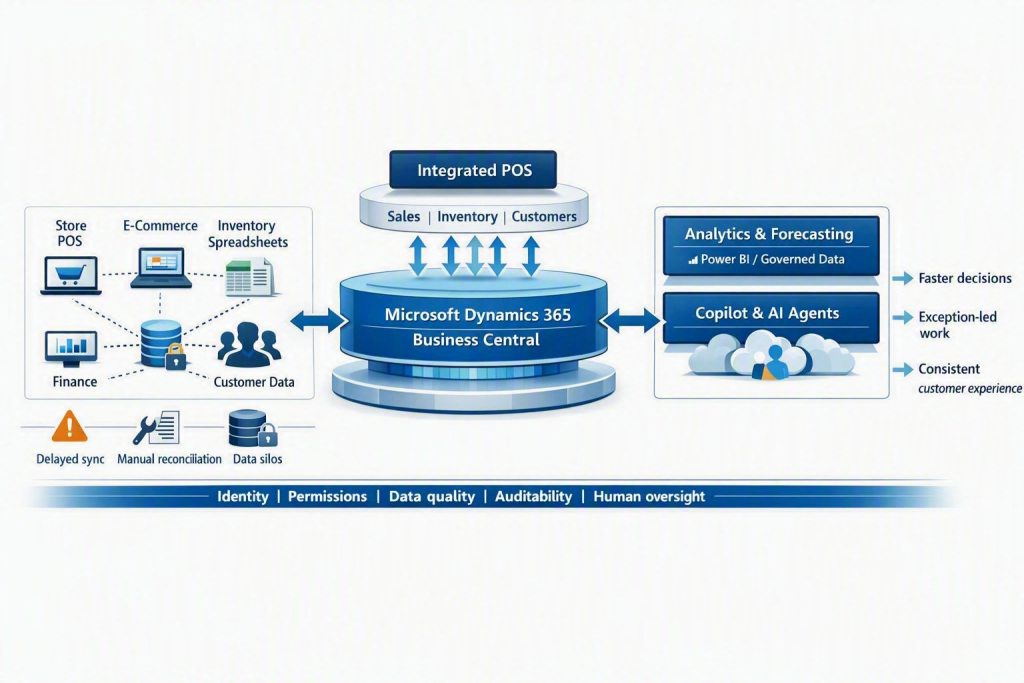
Figure 1: Retail transformation creates value when transactions, inventory, finance and customer data share a governed operational core—allowing analytics and AI to act on consistent, current information.
Business Central’s role in this architecture is not necessarily to replace every specialized retail application. It is to provide a controlled operational and financial centre around which appropriate retail capabilities can participate. This allows organizations to preserve industry-specific functionality while reducing the duplication, re-entry and reconciliation that typically accumulate between systems.
For existing Business Central customers, the priority should be to identify where business events still leave the platform and return later through manual work or batch processes. For organizations evaluating Business Central, the more useful question is not simply, “Does the ERP support retail?” It is, “Can our complete transaction lifecycle remain visible, governed and financially coherent as channels and locations multiply?”
Connected Data is the Prerequisite for Intelligent Retail
The next stage of retail transformation is not just better reporting. It is a progressive movement from recording events to understanding, prioritizing and eventually acting on them.
Business Central already provides inventory analytics designed for different decision levels. Leadership can examine inventory movement and ageing; managers can analyze stock by location; and operational teams can work with bin, lot and serial information. Microsoft’s inventory application also includes views covering demand, scheduled receipts, item availability and forecasting.
These capabilities become much more valuable when the underlying data is timely and consistent. An elegant dashboard built on fragmented inputs merely visualizes disagreement faster. A demand forecast cannot compensate for incomplete sales history, inconsistent item definitions or delayed stock movements. Microsoft’s retail guidance makes the same point: accurate, accessible and secure data is the foundation for AI, personalization and unified customer experiences.
This is why the emerging conversation around Copilot and AI agents should begin with process and data design, not novelty. But the strategic opportunity is not “AI everywhere.” It is intelligence at the points where delay, repetition or complexity currently constrain the business. A retailer might begin by helping managers surface unusual inventory movements, prioritize replenishment exceptions or interrogate sales and stock data conversationally. Only after the relevant information, controls and accountability are proven should an organization expand towards automated action.
Governance must Advance with Automation
Connected operations increase the speed at which information moves. Agents increase the speed at which decisions and actions can occur. Governance must therefore be designed into the transformation rather than added afterwards.
Microsoft’s Business Central MCP server provides read-only access to exposed API pages by default; create, update and delete operations require explicit configuration. Microsoft’s preview agent framework also applies the intersection of the initiating user’s permissions and the agent’s permissions, so the agent cannot exceed the privileges of the user who scheduled the task.
These are useful controls, but technology settings alone are not a governance model. Retail leaders should also define:
- Which system owns each customer, item, price and inventory record
- Which events must move immediately, and which can tolerate delay
- Which exceptions require human review
- Who owns an automated decision and its business outcome
- How data quality, permissions, failures and agent activity will be monitored
- Which workflows must remain operational during connectivity interruptions
The objective is not to slow innovation. It is to ensure that faster operations remain explainable, auditable and resilient.
Five Leadership Priorities for the Next Phase
Retail decision-makers can bring greater discipline to modernization by applying five practical principles.
- Start with critical business events
Map out the moments that affect revenue, stock, cash or customer trust: sale, return, stock transfer, online reservation, price change or payment. Determine how quickly every affected function needs to know about each event
- Establish an operational source of truth
Define where products, prices, customers, inventory and financial postings are mastered. “Single source of truth” should mean agreed ownership and governed definitions, not simply copying every record into another database
- Modernize complete workflows, not isolated interfaces
Connecting POS to ERP is valuable only if the resulting process also handles exceptions, returns, approvals, offline continuity and financial reconciliation. Transformation should remove work across the lifecycle, not move it to another department
- Separate insight, recommendation and action
Use analytics to establish visibility, introduce AI to assist interpretation, and permit autonomous action only where permissions, confidence thresholds and review mechanisms are appropriate. This creates a safer path from connected data to intelligent operations
- Measure decision speed as well as system performance
Technical uptime and transaction speed remain essential, but leadership should also examine how long it takes to confirm inventory, investigate discrepancies, reconcile sales, understand location performance and respond to exceptions
The Future Belongs to Connected Retailers
Retail technology strategy is moving beyond the question of how to connect more systems. The more valuable question is how to create a business that senses, understands and responds as one organization
For retailers using Business Central, that journey can begin by eliminating the remaining gaps between the store and the enterprise. For organizations evaluating the platform, it means assessing Business Central not only as an accounting or ERP application, but as the potential operational core of a broader retail ecosystem.
At Linc, we believe the strongest transformation strategies combine platform knowledge with an understanding of real operational complexity. The goal is not technology for its own sake. It is to create the visibility, governance and adaptability retailers need to serve customers confidently today and to adopt tomorrow’s intelligence without rebuilding the business around it.
For retail businesses who want to see these capabilities demonstrated rather than described, watch the full video on Linc’s YouTube channel: https://youtu.be/evGixwO7PAY?si=JJ4gwWGwDrXMZN6p