
For growing organizations, the next competitive advantage will not come from collecting more data. It will come from reducing the time between an operational event, a trusted insight and a well-governed decision.
Microsoft Dynamics 365 Business Central Version 28 – a part of the 2026 Release Wave 1 – is easy to approach as another collection of product enhancements. Yet the more important message emerging is strategic: ERP is evolving from a system that documents the business into a platform that helps people understand and act on the business. The release brings this direction to life across AI-assisted work, reporting, user experience, financial controls and supply-chain processes. The significance is not any single feature. It is the cumulative reduction of friction between data, interpretation and action.
The Problem: Businesses Have Data, but Decisions Still Arrive Too Late
As organizations grow, their information environment often becomes more sophisticated without becoming more responsive. Finance may have a trusted general ledger, operations may have detailed inventory and purchasing records, and management may have dashboards and spreadsheets. Yet answering an unexpected question can still require multiple exports, reconciliations, report requests and conversations about which figure is correct. This is the hidden cost of decision latency: the elapsed time between recognizing a business question and acting on a defensible answer.
Recent research illustrates the scale of the challenge. A 2026 survey reported by CFO.com found that 57% of finance leaders had missed a time-sensitive strategic action because financial visibility arrived too late. The same research found that 70% lacked a single source of truth for critical business data, while finance teams were spending just over half their time on manual work. Deloitte’s CFO Signals research similarly found that 50% of surveyed North American CFOs identified digital finance transformation as a top priority for 2026, while 87% expected AI to be extremely or very important to finance operations. [deloitte.com]
The issue is therefore not simply “old reporting.” It is an operating-model problem. When reporting depends on manual intervention, operational and financial perspectives become disconnected. Finance explains what happened after the fact, operations act without complete financial context, and IT becomes the intermediary for questions that should be answered closer to the point of decision.
The following diagram illustrates the shift Business Central V28 supports – from fragmented reporting and repeated hand-offs towards embedded, governed decision support.
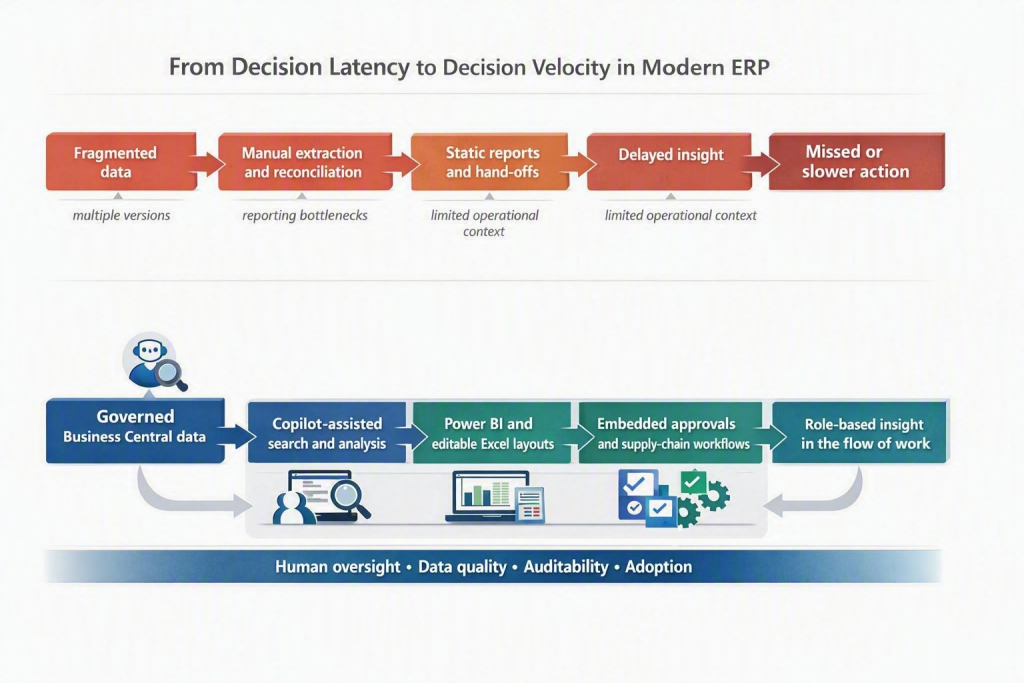
Figure 1: Business Central V28’s strategic value is not a longer feature list, but a shorter, better-governed path from operational data to business action.
The Business Impact: Friction Compounds as the Organization Scales
Decision latency rarely presents itself as one major failure. It accumulates through small delays: a purchasing team waiting for approval, a finance user manually matching an invoice, an analyst rebuilding an inventory report, or a manager searching through pages to find a customer, order or overdue balance.
Each delay may appear manageable in isolation. At scale, however, the organization becomes dependent on a small group of experienced users who know where information lives, how reports are constructed and which workarounds keep processes moving. That creates three interconnected risks.
First, management becomes more reactive. By the time the margin, stock, cashflow or supplier issue is visible, the best intervention window may already have closed. Second, control can become dependent on manual effort: reconciliations, approvals and report validation consume capacity that could be directed towards analysis. Third, technology adoption stalls because new functionality is introduced without changing the underlying workflow or helping users understand how their daily decisions should improve.
The Strategic Response: Turn ERP into a Decision Environment
- Reduce the knowledge required to reach the right information
Traditional ERP navigation assumes that users know the system’s terminology, menu structure and data model. That assumption becomes increasingly limiting as more people require access to operational and financial insight.
Business Central’s advanced search, Copilot chat and assisted analysis allow users to ask for action or information in more natural terms, for example, finding a recent sales order, listing overdue vendor invoices, running depreciation or analyzing sales by region. Copilot can also support list analysis and help users understand records without reviewing every field individually.
For leaders, the opportunity is not to replace expertise with a chat interface. It is to lower the access barrier around expertise. When users can reach relevant records and analysis more directly, experienced finance and IT specialists spend less time acting as system navigators and more time applying judgement.
- Bring analysis closer to the operational moment
Many organizations have invested in dashboards but still experience reporting bottlenecks because insight remains separated from work. The strategic objective should be to make analysis available where purchasing, sales, finance and inventory decisions are being made, as highlighted by Microsoft’s continued modernization of Business Central’s Power BI applications, actual-versus-budget reporting, vendor quality analysis, inventory analytics and an enhanced Subscription Billing app. It also highlights the movement towards editable Excel and Word report layouts, including new inventory reports and a combined Item Age Composition report covering both quantity and value.
This combination matters. Power BI supports interactive management insight, while Excel remains a familiar working environment for many finance and operational users. The goal is not to force every decision into one reporting tool. It is to establish governed definitions and then provide fit-for-purpose ways to examine them.
Financial reporting enhancements reinforce this direction through tile-based views, report statuses, categories, company-specific defaults, scheduling with filters and audit logs. Reporting is consequently becoming less about producing isolated documents and more about managing a controlled information lifecycle.
- Remove friction where finance and operations intersect
Some of the most valuable ERP improvements are not dramatic. They eliminate recurring points of friction where operational activity must become a controlled financial transaction.
Version 28 includes approval capabilities for requisition worksheets and item journals, improved filtering of receipt and shipment lines, support for matching purchase invoices to multiple order and receipt lines, and the ability to email posted shipment and return documents. These changes connect procurement, inventory movement, invoicing and control more closely.
For a CFO, that can mean better discipline around adjustments and purchasing activity. For operations, it can mean less time locating the correct documents or resolving mismatches. For IT, it can reduce pressure to build custom workarounds around standard transactional gaps.
- Treat AI adoption as a controlled workflow redesign
AI adoption should not begin with the question, “Where can we switch on Copilot?” It should begin with, “Which decision or workflow needs to become faster, more consistent or less dependent on manual intervention?”
Business Central’s direction towards AI-driven ERP includes embedded Copilot capabilities and agents working within business processes, while Microsoft emphasizes security, responsible AI and human oversight. V28’s record-creator and modifier avatars also improve visibility into who – or which agent – has interacted with records, helping reinforce task ownership and traceability.
AI delivers value when it operates inside clear process boundaries: trusted data, defined permissions, review points and measurable outcomes. In finance especially, speed without accountability is not transformation; it is additional risk.
Leadership Recommendations: A Practical Agenda for Business Central Decision-Makers
Leaders evaluating V28 should avoid turning the release into a blanket feature-enablement exercise. A more effective approach is to organize adoption around business outcomes.
- Identify your highest-latency decisions
Select a small number of recurring questions, such as stock exposure, overdue receivables, supplier performance, margin movement or cash requirements, and measure how long it currently takes to reach a trusted answer.
- Map the workflow, not only the report
Determine where data is captured, where it is re-entered, who validates it, which spreadsheet or approval creates delay, and what action should follow the insight.
- Prioritize embedded capabilities before custom development
Evaluate whether conversational search, analysis assistance, standard Power BI apps, Excel layouts, financial-report scheduling or improved document workflows can address the problem before another bespoke solution is commissioned.
- Define AI guardrails early
Establish data ownership, access permissions, review responsibilities and audit expectations. Human oversight should be designed into significant finance and operational decisions rather than added after implementation.
- Measure adoption and value together
Track more than logins or feature activation. Appropriate measures might include report-preparation time, invoice-matching effort, approval turnaround, manual adjustments or time from management question to agreed action.
- Treat each release as part of continuous improvement
Microsoft’s release model means capability will continue to evolve. Organizations therefore need a repeatable process for reviewing releases, testing relevant functionality, training role-based users and retiring unnecessary workarounds.
This is where an experienced Business Central partner adds value – not by promoting every new capability, but by helping the organization distinguish between what is interesting and what will materially improve a decision, process or control.
Conclusion: The Real Upgrade Is Organizational
Business Central V28 signals a broader shift in ERP. Systems of record are becoming systems of interpretation and increasingly systems of assisted action. But technology alone will not eliminate decision latency. Value depends on whether organizations simplify workflows, strengthen data discipline, redesign reporting and give users the confidence to work differently.
The leadership question is therefore not simply, “Are we ready to upgrade?” It is:
Where could better-connected data, embedded analysis and controlled automation help our organization decide and act sooner?
For leaders who want to see these capabilities demonstrated rather than described, watch the full video on Linc’s YouTube channel: https://youtu.be/AHQVOjlRu5I?si=ydk0e4OsoHpr7TIS